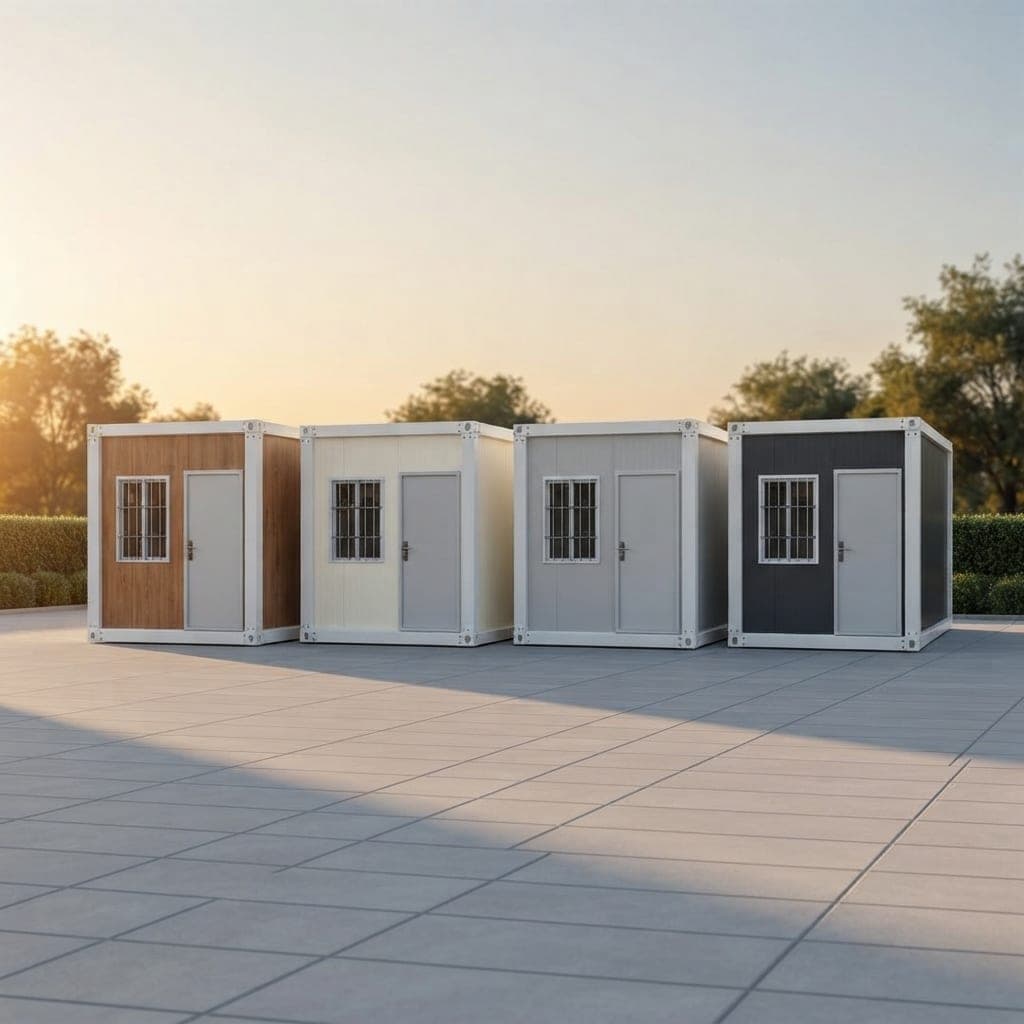
If you want another room on your property in South Africa and you do not want to build it brick by brick, you have three realistic options: a factory-built pod, a converted shipping container, or a wendy house. If you are looking for a wendy house alternative, the first two are the usual candidates. They get compared constantly and usually badly, because the comparison is almost always made on sticker price alone.
We sell pods, so read this knowing that. We have tried to be useful rather than flattering, and there is a section below on where a pod is the wrong choice.
The short version
| Housing pod | Container conversion | Wendy house | |
|---|---|---|---|
| Typical entry cost | Housing podFrom R 54 900 ex VAT | Container conversionVaries widely with the conversion | Wendy houseThe cheapest of the three |
| Built where | Housing podIn a factory, delivered finished | Container conversionConverted in a yard, or on site | Wendy houseAssembled on your site |
| Insulation | Housing podBuilt in | Container conversionAdded during conversion | Wendy houseOften none as standard |
| Shape of the space | Housing podDesigned as a room | Container conversionFixed by the container | Wendy houseDesigned as a room |
| Time on your property | Housing podHours to a few days | Container conversionDays | Wendy houseDays |
| Can it be moved later | Housing podYes | Container conversionYes | Wendy houseSometimes, with damage |
Insulation is the whole argument
Almost every real difference between these three traces back to one thing: whether the walls stop heat, and whether that was designed in or added afterwards.
A shipping container is a steel box. Steel conducts heat superbly, which is exactly what you do not want in a Gauteng summer or a Free State winter, and an unlined container swings between uninhabitable extremes. Container conversions therefore have to add insulation internally, and doing it properly — with a vapour barrier and a ventilation strategy — is the difference between a comfortable room and a condensation problem. It can absolutely be done well. It also eats the internal dimensions, which were tight to begin with.
A wendy house, in its common form, has no insulation at all. Timber or nutec panels, a roof, and that is the specification. That is fine for storage and it is why the price is what it is. As a room someone sits in through a February afternoon, it is a compromise most people notice quickly.
A pod has insulation as part of the panel. Our X-Fold uses EPS-insulated panels; the expandable homes use 75 mm EPS walls with a polyurethane upgrade available; the nature cabins and glamping capsules use polyurethane and multi-layer insulation respectively. Nothing is added on site, so nothing depends on how carefully somebody lined it afterwards.
The shape of the space
A shipping container is 2.44 m wide externally, and the internal width after lining is meaningfully less. That constraint is fixed, and it is unforgiving in a bathroom or a bedroom where a door has to swing. It also means the layout of a container home is largely decided by the container rather than by you.
Pods and wendy houses are drawn as rooms first. Our expandable homes reach 74 m² and up to four bedrooms precisely because nothing about the format forces a 2.44 m width; the glamping capsules put rooms either side of a central bathroom in a way a container cannot.
How long each one lasts, and what it is worth afterwards
Be sceptical of lifespan numbers in this market, including anyone's. Too much depends on the site, the coastal exposure, the maintenance and the quality of the original build for a single figure to mean much, which is why we do not publish one. What is worth comparing instead is what fails first.
- Wendy house: the timber and the fixings, particularly where water gets in at the base. Maintenance is ongoing and non-optional.
- Container conversion: rust at the cut edges — every opening cut for a window or door breaks the factory coating — and condensation behind poorly executed lining.
- Pod: the finishes and the seals, as with any building. The steel frame is the part least likely to be the problem.
On resale, all three do better than a built room in one specific way: they can leave with you. A pod folds down or lifts out, a container lifts out, and a wendy house can sometimes be dismantled. A brick room cannot. If there is any chance you will move, that optionality is worth real money.
Where a pod is the wrong answer
Three situations where we would tell you to buy something else:
- You need storage, not a room. If nobody will sit in it, insulation and finishes are money spent on nothing. Buy a wendy house.
- Nothing can reach the site. Pods arrive whole and have to be lifted or rolled into place. A steep, narrow or overgrown approach can make delivery impossible, and something assembled on site is then the only option. Our X-Fold is the exception — it ships flat and is carried in — but the rest need access.
- Your budget is genuinely fixed below the entry price. Do not stretch to the cheapest pod by cutting the groundwork or the connections. A well-built wendy house on a proper base beats a pod standing on an inadequate one.
The comparison that actually decides it
Set the sticker prices aside and compare delivered, standing, connected and usable. Add transport, groundwork, connections and — for a container — the conversion and lining. That is the number that differs from the advertised one by the largest margin, and it is the only one that lets you compare a R60 000 quote to a R250 000 quote honestly.
Then go and stand inside all three. Fifteen minutes does more than a week of reading, and it is the step people skip.
One more check before you buy any of the three: if someone will live or sleep in it, read whether a wendy house or tiny home needs building plans. The answer changes with the use, not the material.
Our units are on site in Centurion and viewing is free, with no obligation to buy.
Book a free viewingQuick answers
An unconverted container is cheaper than any pod. A properly converted, insulated and lined container home frequently is not, because the conversion is where the cost sits. Compare finished, insulated, connected units rather than a bare container against a finished pod.
For a room someone occupies, yes — insulation, factory finishing and weatherproofing are built in rather than added. For storage, a wendy house is the sensible buy and a pod is money spent on comfort nobody is there to use. Our X-Fold at R 54 900 ex VAT overlaps the premium nutec end of the wendy house market, which is where the two genuinely compete.
A self-contained unit rather than a standard wendy house, which in its common form is panels and a roof. Our expandable homes arrive with a bathroom and a small basic kitchen from R 199 900 ex VAT, and the nature cabins arrive fully fitted, with bathroom, kitchen and air conditioning. The X-Fold, the unit closest to a wendy house in price, carries electrics only, so a local installer fits the shower and toilet. Either way, budget for connecting water and sewerage to the property, and check with your municipality whether you need plans before anyone moves in.
Yes, and good converters do. It requires insulation, a vapour barrier and a ventilation strategy, executed carefully — the failure mode is condensation trapped behind the lining. It also costs internal space in a format that has little to spare.
Sources
Figures we quote from outside our own price list, and where they came from. Prices for our own units come from the same catalogue the product pages use.
- SANS 10400 — the application of the National Building Regulations — sans10400.co.zaPlain-language reference on the deemed-to-satisfy standards any of these three structures is measured against once it is a habitable room.Checked on
- What it costs to build a house in South Africa — ooba Home LoansContext for the conventional-build end of the comparison.Checked on
Price one, or come and see one
The quote builder prices a specific configuration in a couple of minutes. Or book a free viewing and walk through the units at our showroom in Centurion — no deposit, no obligation.