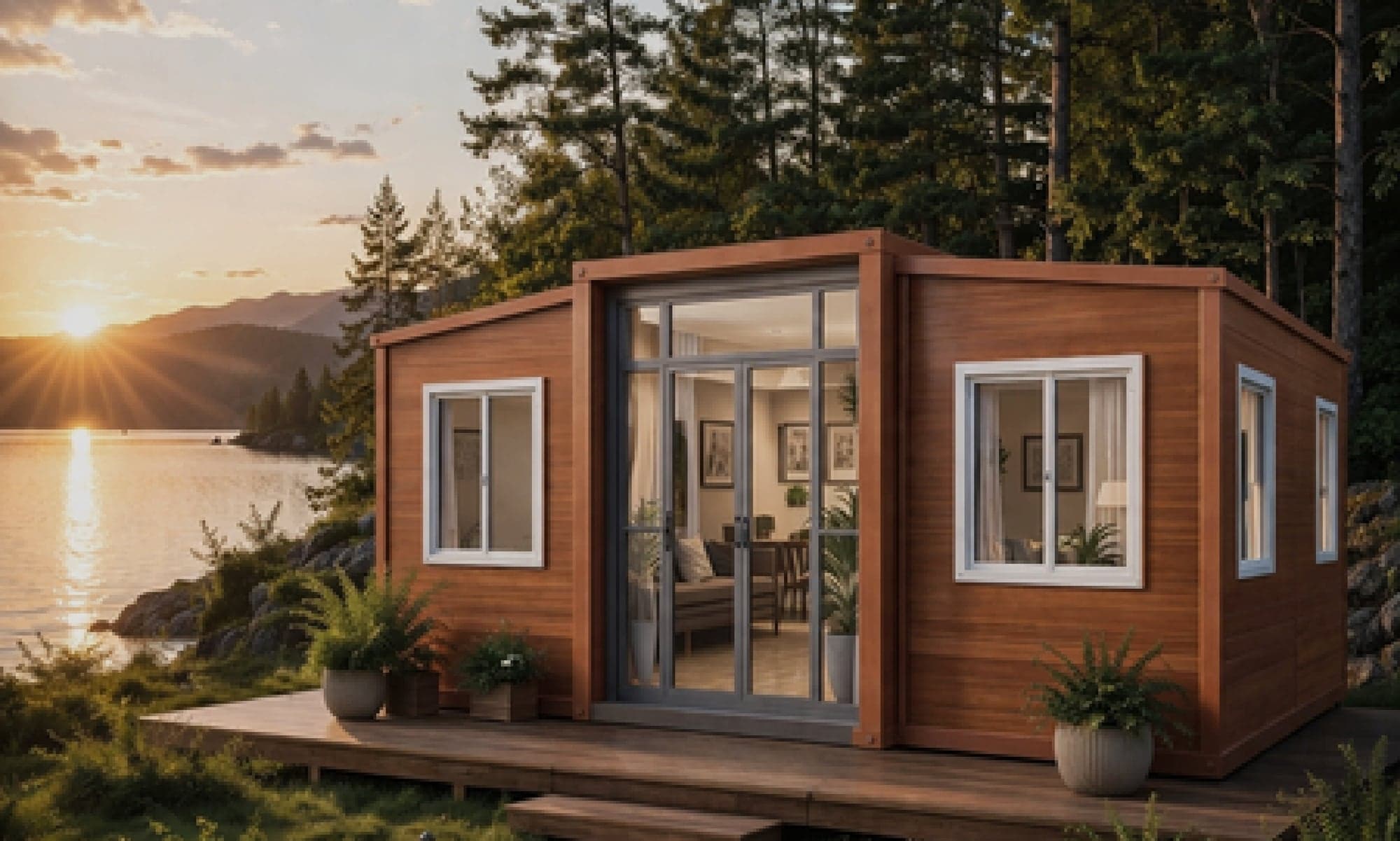
We sell prefab homes, so treat the framing here with appropriate suspicion — and then check the cons list, which is longer and more specific than the one you will find on most suppliers' websites. There are situations where conventional building is straightforwardly the better decision, and pretending otherwise wastes your time and ours.
What you are actually choosing between
Not "cheap versus expensive". You are choosing between a construction project and a purchase.
A conventional build is a project you run: you appoint people, approve drawings, carry the risk of variation, and end up with something drawn for your site. A prefab is a product you buy: fixed specification, fixed price, delivered. Almost every advantage and disadvantage below flows from that one distinction.
Building conventionally: the case for
- It fits the site and the brief exactly. Awkward plot, specific view, a layout your family actually needs — you can draw it. Prefab comes in catalogue sizes.
- Finance is easier. Far more lenders will bond conventional construction than a prefabricated structure. This is the single most underrated practical difference, and we go through the bank-by-bank position in can you get a home loan for a prefab home.
- It matches what is already there. If the new building has to read as part of an existing house, masonry does that and a delivered unit does not.
- Valuation and resale are well understood. Valuers, insurers and buyers have decades of comparable data on brick. Prefab has thinner data, which shows up as caution.
- Marginal cost falls if you are already building. Contractors on site for a bigger job can add a room more cheaply than a separate delivered unit with its own transport and groundwork.
Building conventionally: the case against
- You do not know the final number. You are quoted a rate against a scope, and scope moves. Contingency is not pessimism, it is arithmetic.
- The paperwork is heavy. Plans by a registered competent person, municipal approval, NHBRC enrolment for a new home, an electrical certificate, an occupancy certificate before anyone may move in. Set out in full in what you actually need to put a building on your land.
- It takes months, on your property. Trades, deliveries, noise, dust and a garden you cannot use.
- You carry the coordination risk. When the plumber and the electrician disagree about a wall, that is your problem and your delay.
- It cannot leave. Whatever you spend stays with the property.
Prefab: the case for
- One price, known up front. You are buying a finished unit, not a rate against a scope.
- Speed. Around 90 days from deposit, and on-site setup runs from minutes for an X-Fold to a few days for a cabin or capsule on a prepared base.
- Almost no disruption. The building work happens somewhere else. Your property sees a delivery, not a site.
- Factory conditions. Panels built indoors, to a repeated specification, out of the weather — which is a genuinely different quality-control problem from wet trades on site in February.
- Fewer people to coordinate. A base, a delivery and two connections, rather than five trades in sequence.
- It can move. An X-Fold folds down; a pod lifts out. If you sell, or the use changes, the asset is not stuck.
- A lighter regulatory route may exist. A structure genuinely declared temporary follows a different and much shorter path than a permanent building — with real limits, covered in the guide linked above.
Prefab: the case against
The part most supplier websites skip. All of these are real:
- Finance is harder. Some major South African banks do not currently bond prefabricated structures at all. If you need a bond rather than cash or third-party finance, check this before anything else.
- It is not automatically cheaper. Per square metre our expandable homes land inside the same band as a mid-range conventional build. We ran our own numbers against conventional rates in is a prefab home cheaper than building, and the answer is "sometimes".
- Catalogue sizes. You choose from what exists. If the space has to be a specific shape, this is the wrong product.
- Delivery access can kill it. Every range except the X-Fold arrives whole and must be lifted or rolled into place. Gate width, cables, slope and soft ground decide feasibility, and no amount of budget fixes a site a truck cannot reach.
- Resale data is thinner. Valuers and insurers have less to go on. A relocatable unit on plinths is treated differently from a fixed, approved dwelling — by everyone.
- Approval is not automatically avoided. A permanently founded prefab dwelling generally faces the same municipal approval as any other dwelling. The lighter route exists only for genuinely temporary structures, and it is time-limited.
- Extras add up. The advertised price is factory-gate. Transport, groundwork and service connections are yours, and on a distant or awkward site they are not small.
Side by side
| Build conventionally | Prefab unit | |
|---|---|---|
| Final cost known | Build conventionallyAt the end | Prefab unitBefore you order |
| Time on your property | Build conventionallyMonths | Prefab unitHours to a few days |
| Layout | Build conventionallyAnything you can draw | Prefab unitCatalogue sizes |
| Paperwork | Build conventionallyFull approval path | Prefab unitFull path if permanent; lighter if genuinely temporary |
| Bond finance | Build conventionallyWidely available | Prefab unitRestricted — some banks decline outright |
| Coordination | Build conventionallyYours | Prefab unitLargely the supplier's |
| Weather risk during build | Build conventionallyYours | Prefab unitThe factory's |
| Can it be moved later | Build conventionallyNo | Prefab unitYes |
| Resale comparables | Build conventionallyDeep | Prefab unitThin |
Which one fits your situation
Choose conventional building if…
- You need a bond and cannot use cash or third-party finance.
- The layout genuinely has to be bespoke.
- It must match existing brickwork or form part of a larger renovation already underway.
- Delivery vehicles cannot reach the position.
Choose prefab if…
- Knowing the final figure up front matters more to you than a bespoke plan.
- You want the building usable in months rather than a year.
- You cannot live through a construction site — a working farm, a lodge taking bookings, a home with small children.
- The use might change, or you might move, and a relocatable asset is worth something to you.
- The job is a standard one: a granny flat, a guest unit, staff accommodation, a site office, a rental cabin.
And whichever way you lean, go and stand inside a unit before deciding. Small buildings photograph much larger than they measure, and fifteen minutes settles a question that no amount of comparison reading will.
Units are on site at our showroom in Centurion — free to view, no obligation.
Book a viewingQuick answers
Bond finance is restricted — some major South African banks do not currently bond prefabricated structures at all. Beyond that: catalogue sizes rather than bespoke layouts, delivery access can make a site unworkable at any budget, resale and valuation data is thinner than for brick, and the advertised price excludes transport, groundwork and service connections.
Different, rather than better. Factory assembly means repeatable conditions, indoors, out of the weather — a genuinely different quality-control problem from wet trades working on site in bad weather. But a well-built masonry house by a good contractor is an excellent building, and a poorly specified prefab is still a poorly specified building.
A permanently founded prefab dwelling generally faces the same municipal approval path as any other dwelling. A structure genuinely declared temporary follows a lighter route under regulation A23 — provisional authorisation on layout drawings rather than a full plan set — but it is time-limited, and if it is not extended or converted to a full approval before the period ends, the Act requires the owner to remove or demolish it.
It depends heavily on whether it is fixed and approved. A permanently founded, municipally approved dwelling with an occupancy certificate is treated as property. A relocatable unit standing on plinths behaves more like a movable asset — which is an advantage if you want to take it with you and a disadvantage at valuation.
Sources
Figures we quote from outside our own price list, and where they came from. Prices for our own units come from the same catalogue the product pages use.
- Prefab homes: will the bank grant you a bond? — ooba Home LoansSource for the finance restriction cited in the cons list.Checked on
- National Building Regulations and Building Standards Act 103 of 1977 — SAFLII (consolidated legislation)The Act governing plan approval, temporary buildings and occupancy certificates for both routes.
- What it costs to build a house in South Africa — ooba Home LoansConventional building cost context.Checked on
Price one, or come and see one
The quote builder prices a specific configuration in a couple of minutes. Or book a free viewing and walk through the units at our showroom in Centurion — no deposit, no obligation.