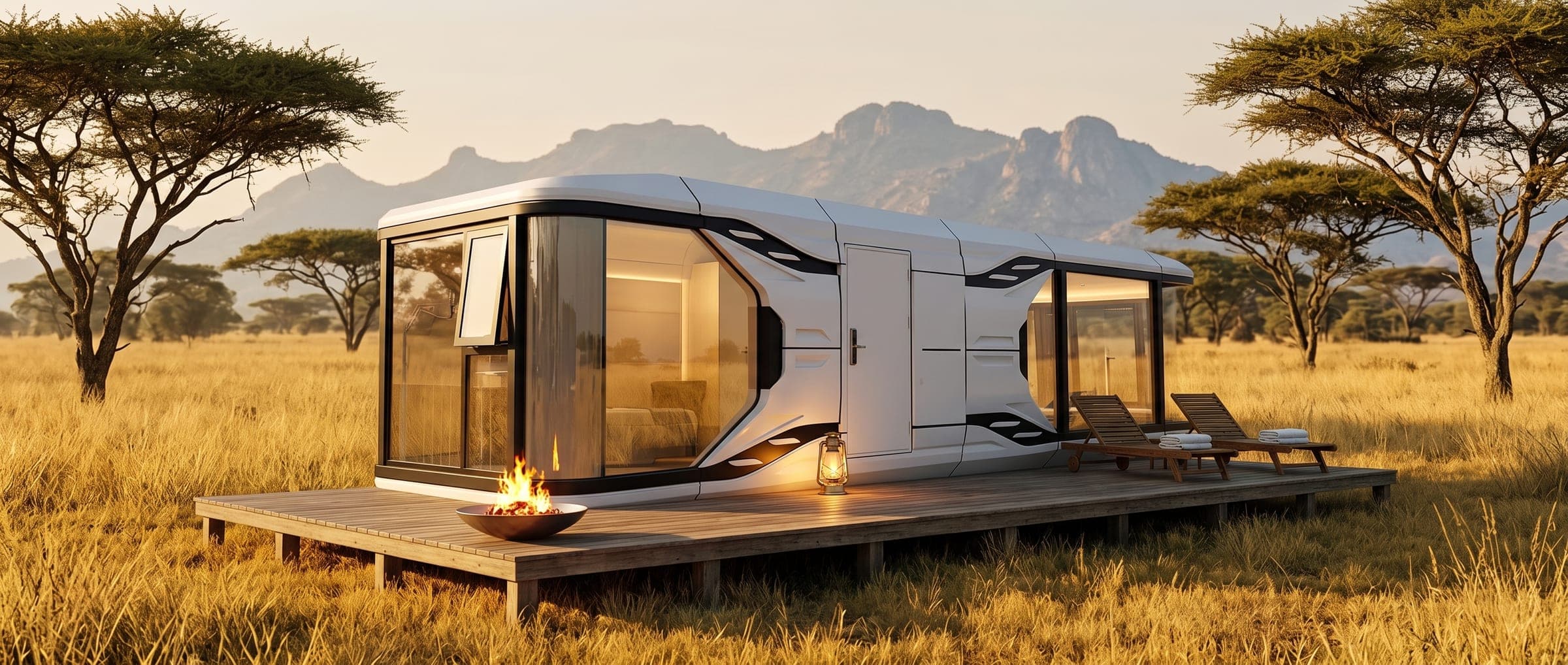
Glamping is a growing accommodation category in South Africa. Market research updated in June 2026 puts the local glamping market at USD 28.1 million in 2025, forecast to reach USD 76.5 million by 2034, a compound growth rate above 11%.
That is the encouraging half. Here is the other half, and the reason to read the arithmetic before the brochure: national accommodation occupancy was reported at 43.9% in July 2026, up from 40.6% in June. Your units stand empty more nights than they are let. Any plan that assumes otherwise is not a plan.
What the units cost
| Unit | From (ex VAT) | Size | Standard inclusions | Suits |
|---|---|---|---|---|
| Apple Cabin | From (ex VAT)R 449 900 | Size13 – 26.5 m² | Standard inclusionsLuxury bathroom fittings all sizes; kitchenette on 9 m and 11.8 m | SuitsEntry to the premium end; strong photography |
| Glamping Capsule | From (ex VAT)R 689 900 | Size18.6 – 38 m² | Standard inclusionsBathroom + premium fittings, geyser, insulation, smart entry | SuitsFlagship units where the room is the reason for the booking |
| Nature Cabin | From (ex VAT)R 810 900 | Size21 m² + terrace | Standard inclusionsBathroom, kitchen, air conditioning, water heater — all fitted | SuitsLonger stays; nothing left to add |
| Safari Tent | From (ex VAT)On request | SizePer project | Standard inclusionsTrade only — supplied and installed with Bushtec | SuitsLodges and resorts wanting canvas |
A note on the glamping capsules: the bathroom, its premium fittings, a geyser, multi-layer insulation, plumbing and electrics, lighting and intelligent front-door access are standard on every model. The kitchen and air conditioning are extras. For a glamping operation that is usually the right way round — most sites feed guests centrally and do not want a kitchen in every unit — but price it deliberately rather than assuming.
Apple Cabins from R 449 900 ex VAT are the lower-capital entry, with panoramic glazing and luxury bathroom fittings in all three sizes. Nature cabins at R 810 900 are the most completely fitted thing we sell — kitchen, air conditioning and water heater standard — which suits longer stays. Safari tents are a trade offering supplied to businesses and hospitality operators only, quoted per project.
The costs that are not the unit
Unit price is the part everyone budgets. These are the parts that surprise operators:
- Transport to site, quoted on distance and access — and glamping sites are, by definition, usually not next to a main road.
- Groundwork: a level slab or properly levelled plinths, per unit, plus decking and paths.
- Services: water, sewerage or a treatment solution, and power to each unit. On remote sites this is frequently the largest line after the units themselves.
- Approval and land use: tourist accommodation is a land-use question as much as a building one, and a rural stand may need consent for the use, not just plans for the structure.
- Everything a guest touches: linen, furniture, fittings, a booking system, signage, insurance, staff.
The arithmetic that decides it
- Find the real nightly rate for comparable units within an hour of your site. Current live listings, not aspiration.
- Choose an occupancy you can defend. Start below the national figure for a new, unknown site with no reviews. Model 30%, 40% and 50% and see which of them still works.
- Subtract the running cost: cleaning and linen per stay, platform commission, power and water, maintenance, insurance, staff.
- Divide total setup — units, transport, groundwork, services, fit-out — by annual net. That is payback in years.
- Then ask what happens in a bad year. A site that only works at 55% occupancy is a site that fails in its first winter.
We can tell you exactly what a unit costs, delivered. We cannot tell you what it will earn, and any supplier who offers you a yield figure for your site is guessing with your money.
What makes a unit book
The reason this category grew is that the accommodation itself became the product. A guest chooses a pod over a perfectly good hotel room because it photographs unlike anything else and because it puts them somewhere a hotel cannot. Practically, that means:
- The view through the glass is the product. 270° glazing pointed at a parking area is money wasted. Site the units for the outlook before anything else.
- Separation matters more than size. Guests pay for privacy. Units in a row facing each other undo the thing they came for.
- Year-round comfort protects the rate. Insulation, glazing and heating are what let you charge in July as well as December. Air conditioning is an extra on the capsules — for a commercial site it is rarely optional.
- Delivery speed is revenue. Capsules and Apple Cabins arrive fully built and are ready within hours to days on a prepared site, so the site is not closed for a construction season.
Units are on site at our showroom in Centurion — worth walking through before committing capital to a fleet of them.
Book a viewingQuick answers
The units are the biggest single line: Apple Cabins from R 449 900 ex VAT, glamping capsules from R 689 900, nature cabins at R 810 900. On top of that budget transport, a level base per unit, water, sewerage and power to each site, decking and paths, and full guest fit-out. Land use and building approval are separate again.
Glamping capsules where the unit itself is the reason for the booking and you want the highest nightly rate; Apple Cabins where you want the premium look at lower capital per key; nature cabins for longer stays, since kitchen, air conditioning and water heater are fitted as standard. Safari tents are trade only, quoted per project.
National accommodation occupancy was reported at 43.9% in July 2026 and 40.6% in June. A new site with no reviews should model below that and check the plan still works at 30%. Any model that only breaks even above 50% is fragile.
Usually, and tourist accommodation raises a land-use question as well — a rural stand may need consent for the use itself, not just plans for the structures. Both are decided by your local municipality, so speak to them before committing to a layout.
Sources
Figures we quote from outside our own price list, and where they came from. Prices for our own units come from the same catalogue the product pages use.
- South Africa glamping market size, share and forecast — IMARC GroupSource for the market size: USD 28.1m in 2025, forecast USD 76.5m by 2034, an 11.42% CAGR over 2026 to 2034 (page last updated 12 June 2026).Checked on
- South Africa accommodation occupancy rate — CEIC DataSource for the national occupancy figures, which CEIC takes from Statistics South Africa: 43.9% for July 2026 and 40.6% for June 2026.Checked on
- Tourism statistics — Statistics South AfricaOfficial tourist accommodation and tourism releases — the primary data behind occupancy and income figures.
Price one, or come and see one
The quote builder prices a specific configuration in a couple of minutes. Or book a free viewing and walk through the units at our showroom in Centurion — no deposit, no obligation.