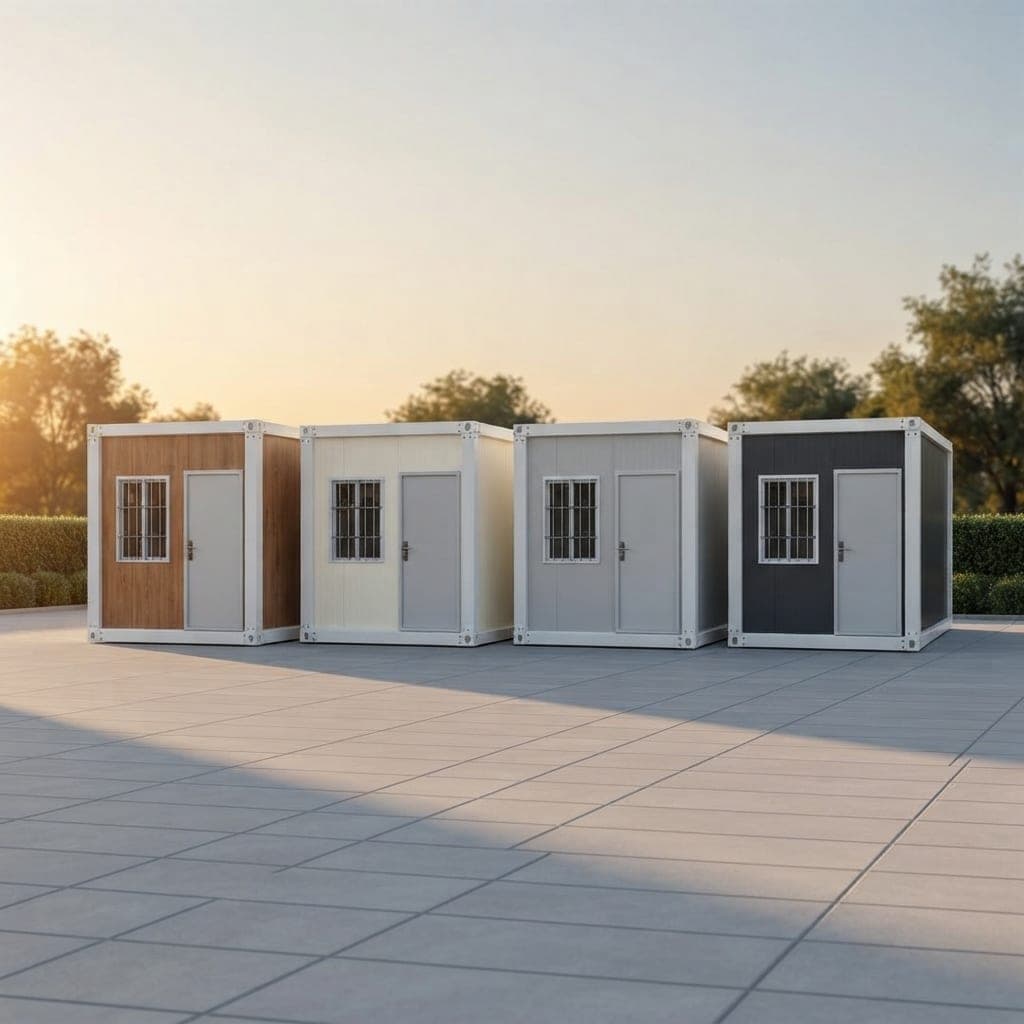
Two money questions arrive here more often than any others, and they usually arrive in the same email: can I rent-to-own it, and can I put it on my bond. The short answer to both is no. That is not the end of the conversation, though, because there is a third route that most of our buyers actually use — and almost nobody in this market explains how it works or what it does to the monthly figure.
Do we offer rent-to-own?
No. We are not a registered financial institution, so we do not offer in-house financing, rent-to-own terms, or instalments of any kind. A home here is either paid for in full or financed by an outside provider — and that provider's credit decision is theirs, never ours.
We say that plainly because rent-to-own is widely advertised in this market, and the arrangement it describes — a supplier holding a unit while you pay it off — is a promise we would rather not make than break. Any arrangement where a supplier holds your money against a unit for a year or two also makes you an unsecured creditor of that supplier, and the question worth asking is what happens to the money you have already paid if the business has a bad year. We would rather not put a customer in that position at all.
Why it cannot go on your home loan
Banks do not generally classify these units as permanent residential structures, which puts them outside what a home loan is secured against. Some lenders will bond a prefabricated home where it is fixed to a permanent foundation and complies with the National Building Regulations, and others will not consider it at all.
That bank-by-bank picture is a whole article of its own, and it is the one to read if you own land and are weighing a fixed, approved build: Can you get a home loan for a prefab home? The rest of this page is about what exists when the answer comes back no.
It is financed as a movable asset, not as property
Here is the part that surprises people. When a third-party provider funds a tiny home, it is not underwritten like a house. It is underwritten like equipment — broadly the same lending category as a truck or a piece of yellow-metal earthmoving plant.
That sounds dismissive until you see why it is good news. A bond lender is asking what a structure will be worth in year fifteen, in a market with thin resale data for prefab. An asset financier is asking something much easier to answer: is this an identifiable, movable, re-saleable thing I could recover and sell? A finished tiny home answers that well. A half-built brick extension answers it terribly. The classification that disqualifies the unit from a bond is the same one that makes it financeable at all.
Three things follow from it, and they are the three that change how you should shop:
- The security is generally the unit itself rather than the land under it — which is the thing a bond cannot do, because a bond needs a title deed to attach to. If your site is family land, a farm or a rented stand, that makes this route worth asking the provider about early. Ask rather than assume: the decision is theirs, not ours.
- The term is short. Asset finance runs over a handful of years rather than decades. Five years is the typical structure.
- It is a credit decision about you, not a valuation of a property. Your credit record and affordability carry the application. There is no bond registration, no conveyancer and no transfer duty in the process.
The five-year term is the thing to plan around
A bond runs for twenty years. Finance on a unit like this is typically structured over five. Same capital, a quarter of the time — and that, far more than the interest rate, is what sets the monthly number.
The table below uses our own prices to show the shape of it. These are capital only. They divide the price by the term and ignore interest, fees, the deposit and VAT, so a real instalment will be higher than every figure here. They are a floor, not a quote — we are not a credit provider and cannot quote you one. What they do show is what the term does.
| Unit | Price ex VAT | Over 5 years | Over 20 years, for scale |
|---|---|---|---|
| X-Fold folding home | R 54 900 | R 920 | R 230 |
| Expandable home | R 199 900 | R 3 330 | R 830 |
| Apple cabin | R 449 900 | R 7 500 | R 1 870 |
| Glamping capsule | R 689 900 | R 11 500 | R 2 870 |
The twenty-year column is not an option on these units. It is there to show you what you are giving up when a bond is off the table, because the gap is roughly fourfold and it is the single biggest thing people get wrong when they budget for a tiny home. A buyer who has been mentally pricing a R1 million house at bond rates and assumes a R 199 900 unit will feel like pocket change is in for a surprise on the first instalment.
The routes that exist, cheapest money first
- Access bond or further advance, if you already own property with equity. Usually the cheapest money available and the longest term, because the bank is lending against the house it already holds rather than against the new unit. Worth checking before anything else.
- Third-party asset finance. Finance available through a third-party provider, subject to credit approval. This is the route most of our customers use, and it is the one the movable-asset structure above describes. Ask us when you request a quote and we will point you at the provider.
- A personal loan from your own bank. Depending on your circumstances and their lending criteria, your existing bank may simply lend you the money as an unsecured personal loan. Faster and less fussy about what you are buying, at a rate that reflects that. Realistic at the lower end of the range rather than for a capsule.
- Cash, in stages. Genuinely workable here in a way it never is with conventional building, because the units are discrete products with published prices. An outdoor kitchen or an X-Fold now and a second unit later is a real plan rather than a fantasy.
What you need before you apply
The provider's requirements are theirs and can change, but an application generally needs:
- A valid South African ID or passport.
- Your latest three months' bank statements.
- Payslips or proof of income.
- A good credit record — this is the part that decides most applications.
- A deposit, which may be required depending on the unit.
One more number to have ready: the total delivered, standing and connected cost, not the unit price. Delivery is quoted separately on distance and site access, and groundwork and connections are real money. That total is what has to be funded, and an application built on the sticker price alone tends to come up short at exactly the wrong moment.
If the finance answer points you at a smaller unit than you had hoped for, that is genuinely useful to learn now. The expandable homes from R 199 900 ex VAT are the cheapest fully self-contained option, and the whole range sits with its prices on the housing pods page.
Price the unit first — the finance conversation is a great deal shorter once you know the number.
Get an instant quoteQuick answers
No. We are not a registered financial institution, so we do not offer in-house financing, rent-to-own terms or instalments. A home is either paid for in full or financed by an outside provider, subject to that provider's credit approval. We can point you at the finance option when you request a quote.
Sources
Figures we quote from outside our own price list, and where they came from. Prices for our own units come from the same catalogue the product pages use.
- National Credit Act 34 of 2005 — South African GovernmentThe framework behind the instalment-agreement and registered-credit-provider points — what makes a rent-to-own arrangement a credit agreement in substance.
- National Credit Regulator — NCRThe regulator that registers credit providers, and where a provider's registration can be checked under Registrants → Credit Providers.
- Prefab homes: will the bank grant you a bond? — ooba Home LoansSource for the position that some major South African banks decline prefabricated structures while others will bond them subject to a fixed foundation and National Building Regulations compliance.
Price one, or come and see one
The quote builder prices a specific configuration in a couple of minutes. Or book a free viewing and walk through the units at our showroom in Centurion — no deposit, no obligation.